Table of Contents
- Why Floor Coating Choice Matters
- Start With the Space
- Compare Common Coating Types
- Check the Concrete Condition
- Plan for Moisture and Temperature
- Build in Safety From the Start
- Choose a Finish That Fits the Space
- Review the Installation Process
- Estimate Maintenance and Long-Term Value
- Questions to Ask Before Work Begins
- Conclusion
Choosing a floor coating involves more than picking a color or deciding how glossy the finished surface should look. The right system must match the condition of the concrete, the amount of traffic, the types of spills expected, and the time available for installation. Homeowners researching epoxy floor coating installation in Salt Lake City, Utah, should start by defining how the garage or workspace will be used day-to-day. A lightly used residential garage has different needs than an auto shop, warehouse, commercial kitchen, showroom, or maintenance bay. The best choice balances durability, traction, appearance, cleaning requirements, budget, and downtime. It also considers the full flooring system, including concrete preparation, crack repair, the base coat, decorative materials, texture, and protective topcoat.
Why Floor Coating Choice Matters
Concrete floors are under constant stress from vehicle tires, dropped tools, carts, foot traffic, oil, cleaning products, water, road salt, and fluctuating temperatures. A coating that looks great in a showroom may not be the right fit for a wet service area or a heavily used loading space. Selecting materials based on real-world exposure conditions can reduce the risk of early wear, staining, peeling, or slick spots that are unsafe.
Start With the Space
Before comparing products, make a practical list of the floor’s requirements. Consider the following questions:
- How often will cars, trucks, forklifts, carts, or heavy equipment cross the surface?
- Will the floor encounter oil, solvents, food products, standing water, or cleaning chemicals?
- Will people carry loads, push carts, or walk on ramps?
- Does the area receive direct sunlight or experience large temperature swings?
- How quickly must the space return to foot traffic, vehicle traffic, or full operation?
Compare Common Coating Types
No single material is automatically best. Each option has strengths and limitations that should be reviewed in light of the space’s conditions.
Epoxy
Epoxy is commonly chosen for indoor concrete floors because it creates a durable, attractive surface with a wide range of colors and decorative options. It is well-suited to many garages, workshops, storage areas, and showrooms, but preparation and curing conditions remain essential.
Polyaspartic and Polyurea
Polyaspartic systems are often valued for fast cure times and strong resistance to sunlight. Polyurea systems can also offer flexibility and the potential for rapid installation. Both can be useful where downtime matters, although fast-curing products require careful application and close attention to temperature and moisture conditions.
Urethane Cement and Sealers
Urethane cement is frequently considered for demanding wet, hot, or chemical-heavy environments. A concrete sealer, by comparison, is a thinner protective treatment that may suit lower-demand spaces where a full multi-layer coating system is unnecessary.
- For faster return to service: Polyaspartic or polyurea may be worth considering.
- For decorative indoor floors: Epoxy offers broad color and flake options.
- For wet industrial conditions: Urethane cement may be more appropriate.
- For basic protection: A sealer can be a practical lower-build option.
Check the Concrete Condition
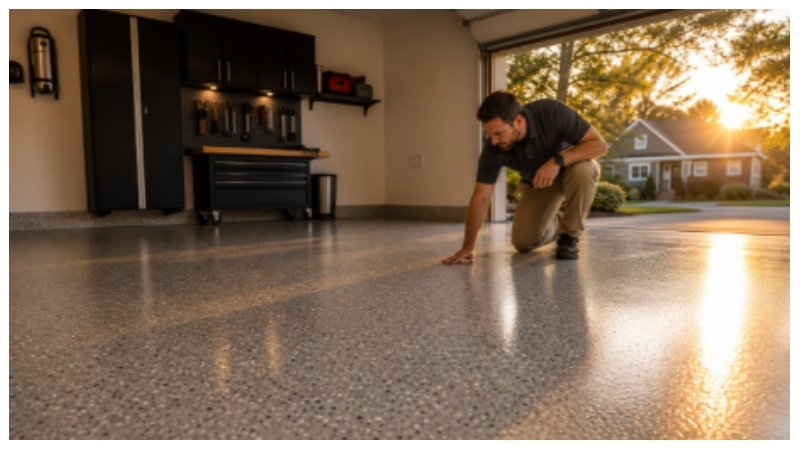
Surface preparation often determines whether a floor coating performs as intended. Inspect the slab for cracks, spalls, uneven sections, open joints, oil contamination, old paint, powdery concrete, and failed coatings. Weak or contaminated material can prevent a new coating from bonding properly. Thorough preparation may include mechanical grinding or shot blasting, deep cleaning, patching damaged areas, and treating joints or cracks. A coating should be installed over a clean, sound, properly profiled surface, not simply placed over visible problems.
Plan for Moisture and Temperature
Moisture moving through concrete can interfere with adhesion and contribute to blistering or peeling. This is especially important in basements, wash areas, older garages, exterior entries, and spaces where snow-covered vehicles regularly melt on the slab. Ask whether moisture testing will be performed before coating work begins. Temperature, humidity, and a cold slab can also influence cure times and final appearance. The U.S. Environmental Protection Agency’s moisture control guidance emphasizes addressing moisture problems before remodeling work, a sensible approach for any coated concrete floor in a damp indoor space.
Built-in Safety From the Start
A glossy floor is not necessarily a safe floor. Slip-resistant additives, broadcast quartz, decorative flakes, and other texture options can improve traction when selected for the environment. The appropriate texture level depends on whether the area is usually dry, occasionally wet, oily, or exposed to ramps and heavy foot traffic. Keep walkways visible, use contrasting colors for work zones, maintain good lighting, and clean spills promptly. OSHA notes that a static coefficient of friction of 0.5 is commonly used as a general guide, while higher traction may be needed for tasks involving ramps, load carrying, or pushing equipment.
Choose a Finish That Fits the Space
Finish choices should support the way the room functions. Solid colors create a clean, uniform appearance. Decorative flakes can help disguise minor dirt and marks while adding visual depth. Quartz broadcasts may be useful where traction is a priority, while metallic finishes tend to work best in appearance-focused spaces. Safety stripes and marked aisles can make equipment areas and pedestrian routes easier to identify.
Review the Installation Process
A careful installation typically includes inspection, cleaning, mechanical preparation, crack and joint repair, base coat application, decorative or traction materials, removal of loose broadcast material, topcoat application, and the required cure period. Shortcuts at any stage can lead to uneven texture, visible defects, poor adhesion, or early wear.
Estimate Maintenance and Long-Term Value
Coated floors still need routine care. Sweep grit regularly, mop with cleaning products approved for the system, clean spills quickly, and avoid dragging sharp metal equipment across the surface. Protective pads under heavy racks, stands, and storage equipment can reduce concentrated wear. When comparing project costs, look beyond the initial installation quote. Include concrete repairs, preparation, expected downtime, cleaning needs, service life, and the potential cost of future touch-ups. Addressing small chips or damaged areas early is often simpler than waiting for larger failures to develop.
Questions to Ask Before Work Begins
- What system is proposed, and why does it fit this specific space?
- How will the concrete be mechanically prepared?
- Will moisture testing be completed?
- How will cracks, joints, pits, and damaged areas be treated?
- What traction options are available for wet or oily conditions?
- When can people, vehicles, and equipment return to the area?
- What cleaning products and maintenance steps are recommended?
- What conditions could shorten the floor’s service life?
Conclusion
The right floor coating depends on the space, the condition of the concrete, the expected exposure, and the daily routine. Prioritizing preparation, moisture planning, traction, and realistic maintenance needs helps create a floor that looks polished, performs reliably, and remains easier to care for in 2026 and beyond. Taking time to compare coating options, understand manufacturer recommendations, and choose products suited to the environment can also improve long-term performance. A well-planned installation enhances durability, simplifies ongoing maintenance, and reduces the likelihood of premature wear, peeling, or costly repairs. Click here for more information.