
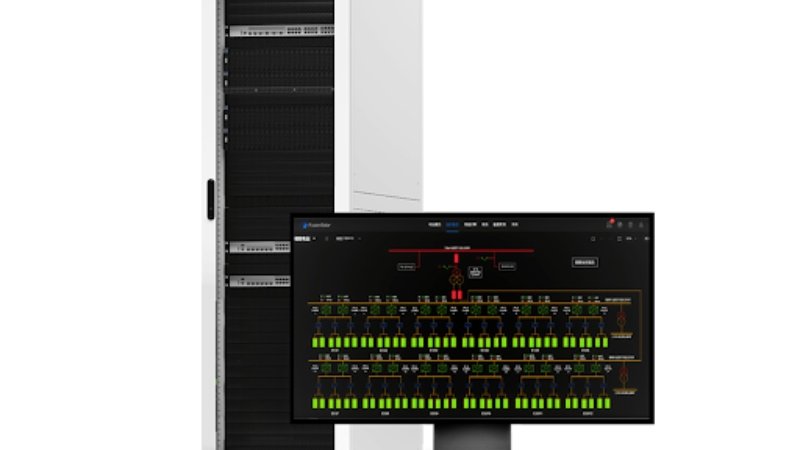
For a hybrid project with variable solar output, equipment decisions must follow the required service and the conditions of the actual site. A microgrid energy management system supervises generation, battery storage, flexible loads and sometimes diesel generators within a local electricity network. The FusionSolar smart microgrid portfolio combines plant management with grid-forming storage and a dedicated microgrid controller for coordinated operations. In this context, microgrid energy management system brings together specific components and controls rather than a single isolated device.
Variable PV output requires short-interval control and realistic storage state-of-charge forecasts. Equipment ratings, control policies and the responsibilities of the operating team should therefore be aligned before commissioning. A design assumption should be documented when it cannot yet be confirmed by measurements.
Supervisory architecture
The management layer collects meters, inverter status, battery state of charge, generator availability, and load information. It creates a consistent operating view, while local protection and converter controls maintain faster electrical safeguards.
Huawei’s Smart Microgrid portfolio lists the SPMS2000 plant management system and SPPC2000-MGCC controller alongside PV and grid-forming storage equipment. Their functions should be specified separately rather than describing all software as a single generic EMS.
Dispatch and resource coordination
Economic dispatch can prioritize solar generation, schedule battery charging and discharging, and limit generator runtime where the electrical design permits. Dispatch targets are bounded by battery power limits, fuel availability, and minimum reserve requirements.
When the grid becomes unavailable, grid-forming equipment may establish local voltage and frequency while the controller coordinates other resources. This transition requires verified protection settings and a stable operating reserve.
Stability, control and alarms
Frequency and voltage control operate on faster timescales than daily energy scheduling. The supervisory system should not conflict with converter-level controls or protective relays during rapid load steps and switching events.
A useful alarm model differentiates communication loss, insufficient generation, battery constraints, and protection events. Trend records support incident review and help teams distinguish a control setting from a physical equipment fault.
Design and ongoing operation
Design tools and simulation can examine expected operating modes before deployment. The supplier describes digital and hardware-in-the-loop validation as part of its microgrid delivery method, though site commissioning remains necessary.
Operators should test grid-connected operation, planned islanding, unplanned disconnection where supported, restoration, and generator start sequences. Each test must specify which loads are allowed to remain energized.
These considerations show why microgrid energy management system should be specified by its architecture, operating limits, and interfaces. The EMS provides the supervisory decisions; grid-forming converters and the microgrid controller provide electrical responses and operating coordination. Treating these layers as distinct is central to a stable and maintainable microgrid. The final selection still depends on applicable standards, actual site conditions, and model-specific documentation.